Inside the Scanning Room: How a Magazine Becomes an Archival Record
From accession number to checksummed master file — the workflow behind every preservation scan we make.
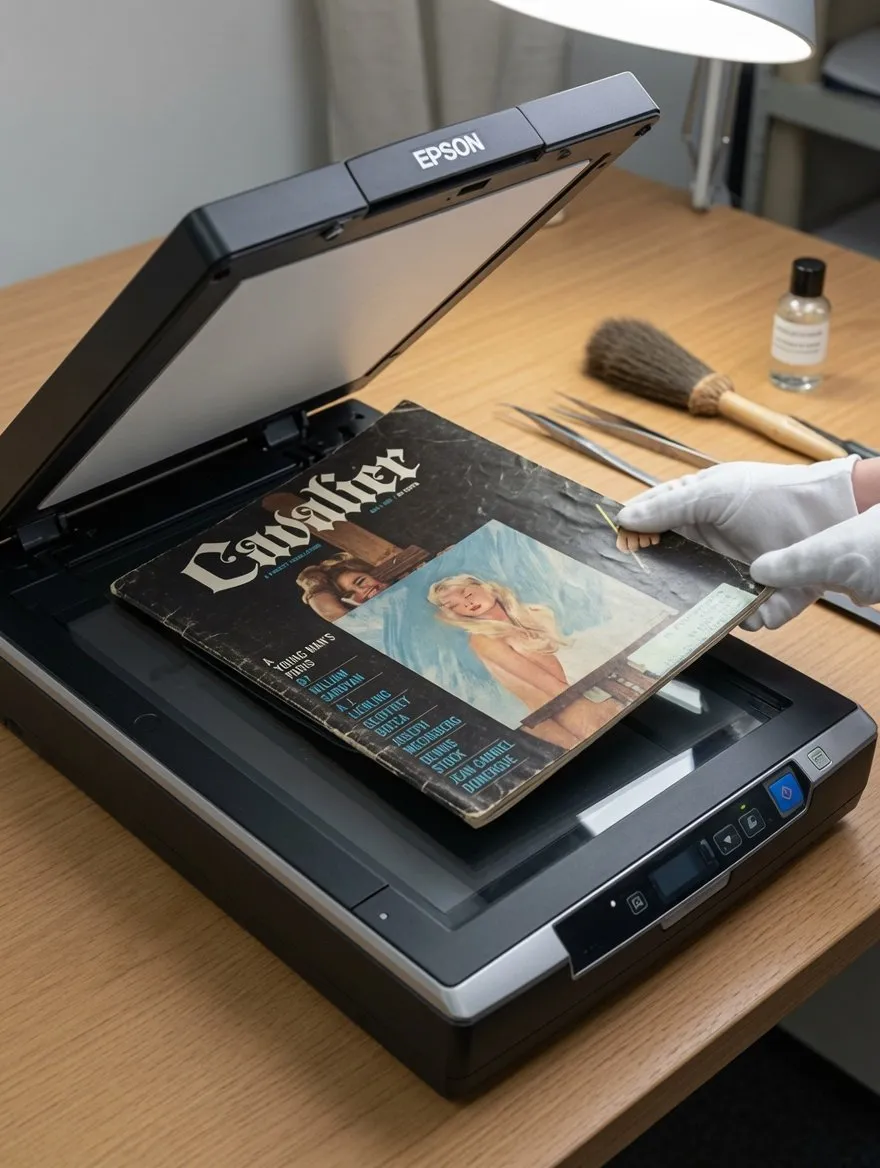
When a magazine enters the archive, it is assigned an accession number — a permanent identifier like PR-MM-1957-06-001 that ties the physical copy, its paperwork, and every file we ever derive from it into one record. What happens next is deliberately unhurried.
Assessment before imaging
Every copy is examined page by page before it goes near a scanner. We note condition, completeness, annotations, and anything tucked between pages — and mid-century magazines are full of tucked things: clippings, receipts, letters, pressed matchbooks. These are recorded as part of the copy’s provenance, not discarded.
Fragile copies are stabilized first. A magazine with a detached cover or brittle spine folds is imaged with supports and cradles rather than flattened; no scan is worth breaking the object it is meant to preserve.
The scan itself
Preservation masters are captured at high resolution in full color against a neutral backing, one page at a time, with a color target in the first frame of every session. We scan the whole object — covers inside and out, advertisements, subscription cards — because the “unimportant” pages are usually the ones researchers ask for. The advertising in a 1957 monthly is a document of its economy; the letters column is a document of its readers.
Masters are saved as uncompressed TIFF files. From each master we derive corrected copies, web-resolution images, and thumbnails, but the master itself is never edited. Its SHA-256 checksum is recorded at creation and verified on a schedule, so silent file corruption cannot pass unnoticed.
What we do not do
We do not “improve” the historical record. Halftone dots, registration drift, paper tone, printing flaws — these are information about how the object was made, and preservation scans keep them. When we produce a restored presentation image for an edition, it is labeled as such and stored separately from the archival master. The original scan always remains the record of truth.
We also do not publish everything we scan. Every image asset carries a visibility rating and a rights status, and material that cannot yet be cleared — or should not be displayed publicly — stays within the archive, available to approved researchers under controlled terms.
Why this much process for old magazines?
Because nobody else is doing it for this material. Institutional archives preserved the respectable periodicals; the men’s magazine of this era mostly survives in private hands, without documentation, scattering further with every estate sale. A disciplined workflow is the difference between a pile of scans and a citable record.