Restoration Ethics
Restoration is performed carefully and transparently — or not at all.
Physical conservation
Physical intervention is limited to stabilization: supporting detached elements, safe removal of damaging fasteners or tape where feasible, and protective enclosure. Work is reversible wherever possible, documented in the copy’s record, and disclosed in any sale. We do not bleach, trim, re-staple with intent to deceive, or manufacture “better” copies from parts of lesser ones.
Digital restoration
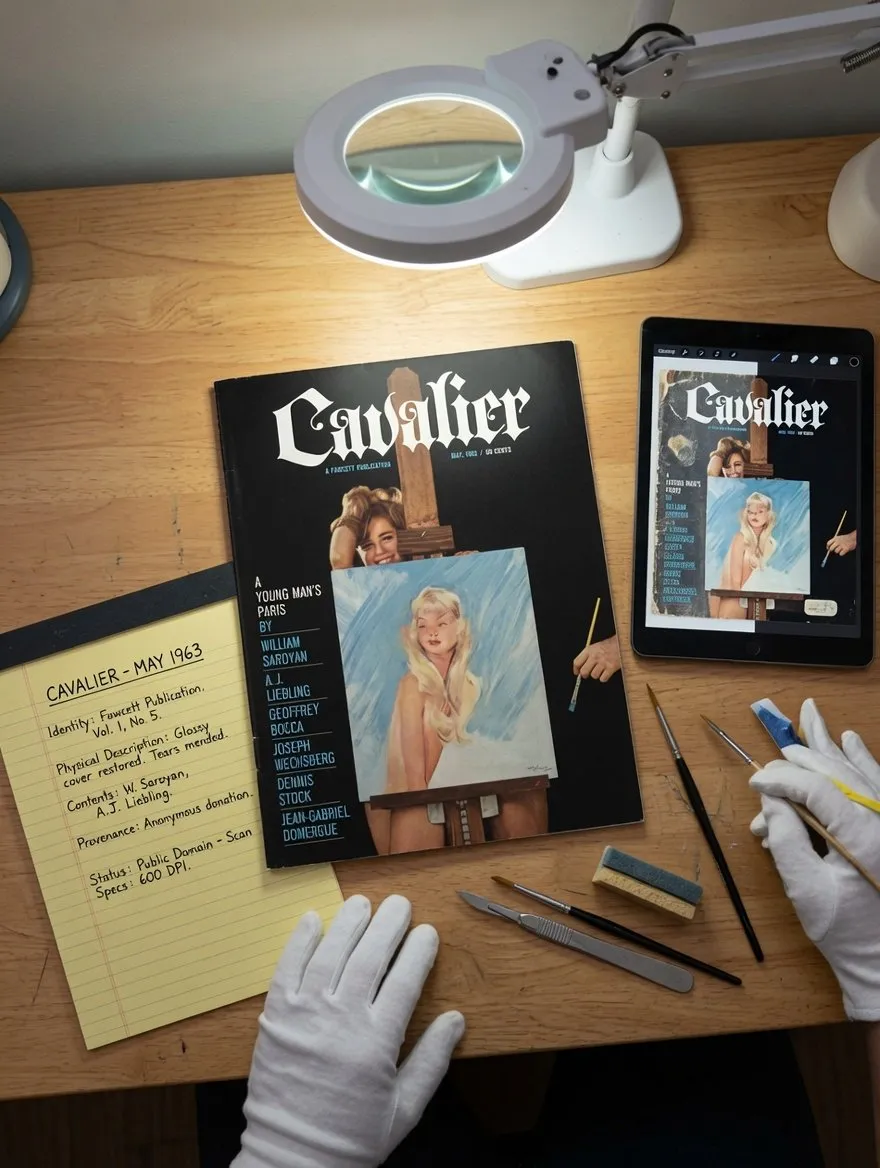
Every image we publish is labeled as exactly one of the following:
- Original scan — the preservation master, as captured.
- Color-corrected scan — tonal correction against targets; content untouched.
- Cleaned preservation image — dust and scanning artifacts removed.
- Restored presentation image — repair of damage (tears, stains, losses) for display or editions.
- Reconstructed element — any area re-created rather than recovered, disclosed explicitly.
The archival master always remains part of the record. A restored derivative never replaces it, and Archive Editions state the restoration class of every plate they reproduce.
What restoration is for
Restoration serves legibility and appreciation of the original design — not modernization. We do not sharpen halftones into contemporary crispness, re-grade mid-century color into current fashions, or use generative tools to invent detail that the source does not contain. An Archive Edition should look like a superb copy of 1957 printing, not like 1957 reshot yesterday.
Accountability
Restoration notes — operator, tools, extent of intervention — are retained for every restored image and summarized publicly on edition pages. If we get something wrong, the correction process applies to our restoration work as much as to our records.