Preservation Standards
What happens, physically and digitally, to every magazine in our care.
Accessioning
Every physical copy receives a permanent accession number (for example,
PR-MM-1957-06-001) linking the object, its source collection, its condition
report, and every file derived from it. Collections are recorded as collections, so
provenance survives even when individual copies are later sold as duplicates.
Handling and storage
- Copies are handled on clean, padded surfaces; fragile items are supported, never forced flat.
- Storage is cool, dry, dark, and stable, in acid-free enclosures and boxes.
- Nothing is pressed, trimmed, laminated, or “tidied.” Inserts, clippings, and owner marks stay with the object and enter the record.
- Condition is graded on our published six-grade scale, always with a written report.
Digitization
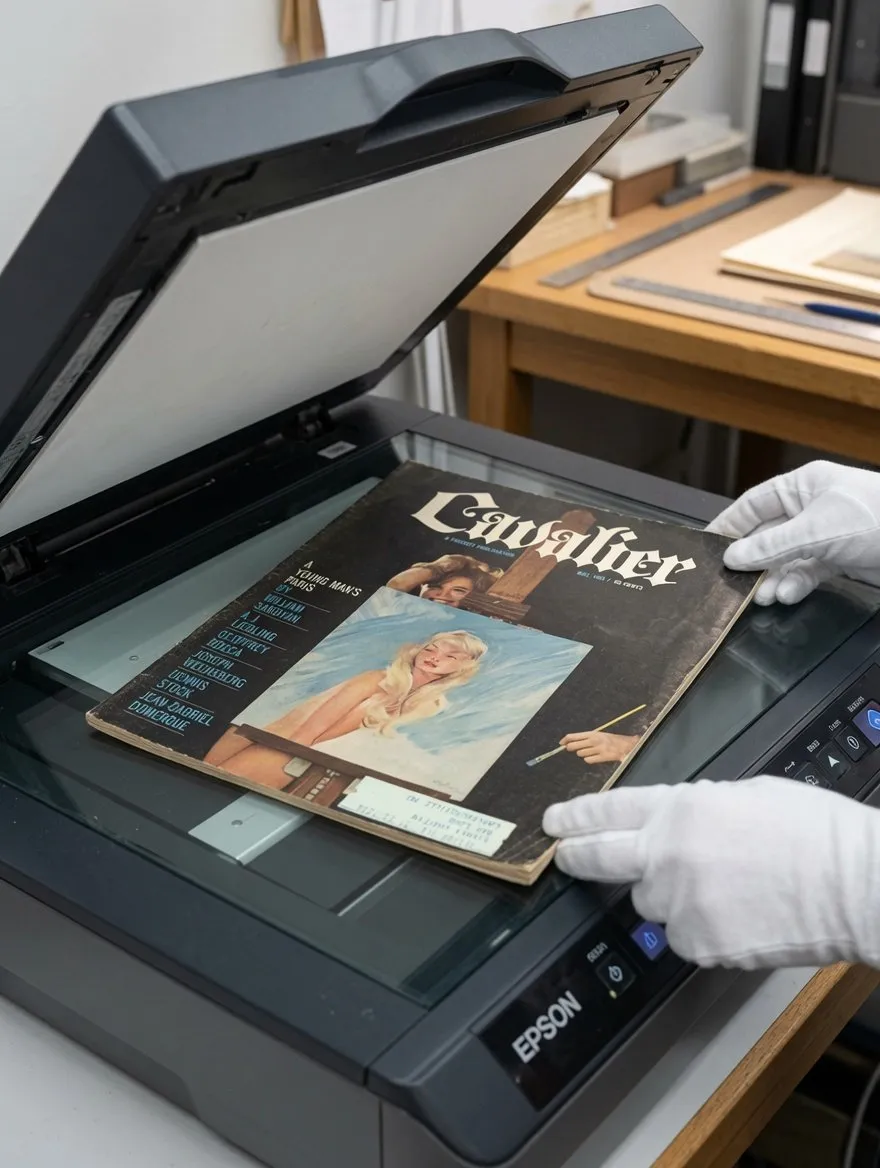
- Preservation masters are captured in full color at high resolution with color targets, covers to cover — advertising and ephemera included.
- Masters are uncompressed TIFF files with SHA-256 checksums recorded at creation and verified on a schedule.
- Derivatives (corrected, web, thumbnail) are generated from masters; the master itself is never edited.
- Preservation masters are never exposed through the public website; public imagery is a deliberately limited, rights-reviewed selection.
Documentation
Issue records aim to capture identity (publication, date, volume, number), physical description, contents and credits, archival information (scan specifications, rights status, visibility), and provenance. Where our information is provisional — and in this field it often is — the record says so rather than pretending certainty. Corrections preserve the original entry, the date, the reason, and the source.
What we decline to do
We do not part out complete issues for their plates or advertisements, do not launder provenance, and do not silently replace archival scans with restored derivatives. Our position on intervention is set out in Restoration Ethics.